Warmer conditions and increasing climate variability
The 2026–27 climate outlook suggests that growers across Australia and New Zealand should prepare for a season marked by above-average temperatures, increasing climate variability and greater pressure on crop resilience. While conditions will differ by region, heat stress is expected to be a common challenge.
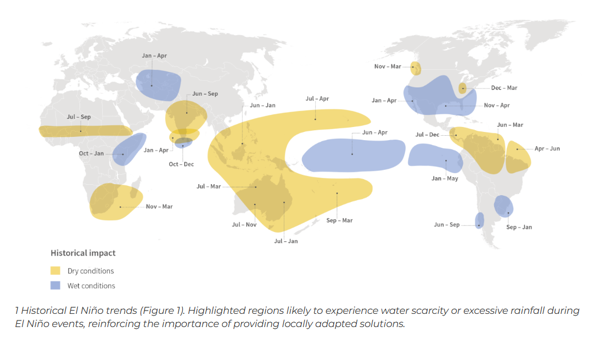
In Australia, the Australian Bureau of Meteorology forecasts above-average daytime and night-time temperatures across most of the country during the coming months. Rainfall patterns are expected to vary significantly between regions, with below-average rainfall more likely in southern Victoria, Tasmania and parts of tropical northern Australia, while above-average rainfall is forecast for much of southern and central Western Australia, western South Australia, southern Queensland and north-eastern New South Wales.
In New Zealand, NIWA Seasonal Climate Outlook indicates that El Niño is likely to be a dominant climate driver through spring and early summer. The north and east of the North Island (Northland, Auckland, Waikato, Bay of Plenty, Gisborne, Hawke’s Bay and Wairarapa) are expected to experience drier conditions, more frequent dry spells and increasing soil moisture deficits. In contrast, the west of the South Island (West Coast region) is more likely to receive above-normal rainfall.
Biosolutions approach
To address these challenges, an integrated biosolutions strategy is recommended, focusing on soil health, water use efficiency and stress management by combining different complementary approaches.
Soil and water management is supported through humic-based solutions such as Humistar and Humifirst, together with Wiibio®, which help improve soil structure and enhance water retention. Optimizing water efficiency is just as important, with Transformer contributing to better moisture distribution in the soil.
At root level, Turbo Root promotes stronger root systems, supporting more efficient water and nutrient uptake. Plant resilience is further boosted through stress management strategies, with Phylgreen 200 and its Primactive effect supporting plant tolerance, while Delfan Plus V help plants respond to stress conditions.
In addition, nutritional support through foliar nutrition and micronutrients contributes to improving nutrient use efficiency, while reproductive performance is supported by calcium, boron and Phylgreen 200, helping maintain flowering and fruit set under stress conditions.
👉 Local technical teams can help to design tailored programs adapted to specific crops and conditions.
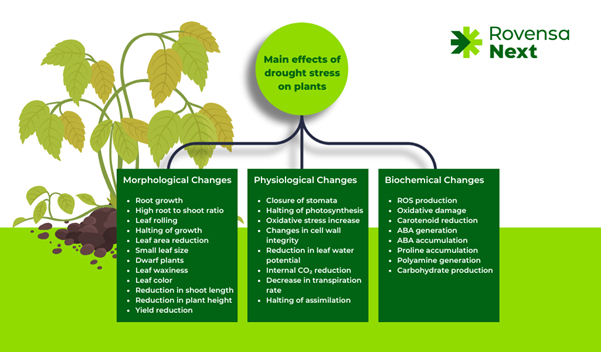
Drought stress response diagram (Figure 2). This diagram showcases the physiological, biochemical, and morphological changes plants undergo during drought stress and how biostimulants mitigate these effects. Source: Rovensa Next
Integrated Pest and Disease Management: the increasing role of biocontrol solutions
Beyond abiotic stress, El Niño conditions can also increase pest and disease pressure as crops become more vulnerable to drought, heat and erratic weather patterns. This makes effective biocontrol an increasingly important part of an integrated crop management strategy.
At the centre of Rovensa Next’s biocontrol offering is PREV-AM, a high-performance solution based on orange oil, a naturally derived plant extract. Powered by Orowet technology, PREV-AM provides broad-spectrum contact activity, helping growers manage key pest and disease pressures while supporting effective, sustainable and residue-conscious crop protection.
PREV-AM complements Rovensa Next’s broader biosolutions approach, integrating biocontrol, biostimulation and nutrition to help growers:
- Maintain effective crop protection during periods of stress.
- Reduce the impact of pest and disease outbreaks.
- Support crop performance, quality and yield potential.
- Build more sustainable and resilient production systems.
This integrated approach becomes particularly valuable under El Niño conditions, where heat, water stress and increased pest and disease pressure can occur together. PREV-AM provides growers with a practical biocontrol tool that fits naturally within a broader strategy designed to protect both crop performance and resilience.
From risk to resilience through biosolutions
Climate variability requires moving from reactive to preventive, integrated strategies to support more sustainable agriculture. In this context, Rovensa Next supports growers in improving resilience and maintaining productivity under stress conditions through integrated biosolutions programs. In line with this approach, Biosolutionize Agriculture, Rovenas Next’s science-backed campaign, shows how biosolutions help growers improve performance and profitability, reduce synthetic load and farm more sustainably across crops and climates worldwide.
El Niño 2026 reinforces the need for adaptation in agriculture. Across Australia and New-Zealand, drought, heat and rainfall variability require targeted solutions.
Growers can reduce risk, protect yields and build long-term resilience by combining biosolutions, regional expertise and climate anticipation.
👉 Contact your Rovensa Next local technical team:
https://www.rovensanext-au-nz.com
Sources and references
Figures:
1 Figure – El Niño trends
https://www.fao.org/el-nino/en/
2 Drought stress response diagram